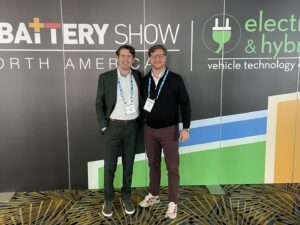
Kip Watson, Director of Business Research, and Dayton Ward, Project Coordinator, represented Charleston County Economic Development (CCED) at The 2024 Battery Show in Detroit, Michigan. This premier industry event provided a platform for professionals in the battery and electric vehicle (EV) sector to connect, share knowledge, and explore opportunities for growth.
Key takeaways from the conference included the importance of battery recycling for sustainability and supply chain resilience. Despite challenges, recycling presents a significant opportunity to onshore battery production and reduce dependence on foreign sources, particularly given that 70% of lithium-ion supply currently relies on China. The potential for a circular value chain is widely recognized as essential for future electrification.
Attendees also gained insights into the basics of battery technology and manufacturing processes, as well as the future landscape of the industry. Projections indicate a substantial increase in jobs along the battery value chain, reaching 10 million by 2030. Advancements in battery technology are expected to contribute to a more sustainable future.
The conference highlighted the evolving market for battery storage, with a growing demand for stationary storage solutions driven by renewable energy. Discussions also addressed the economic impacts of potential delays in EV adoption, focusing on range anxiety and charging infrastructure challenges.
Keynote speakers from GM and Volkswagen Group America shared their companies’ commitments to an all-electric future, emphasizing the ongoing momentum in the EV sector and the need for strategic planning and collaboration across the industry.
A particularly engaging session led by The Boston Consulting Group focused on state and local economic development strategies to attract investment and talent in the battery sector. With South Carolina taking an aggressive stance toward incentivizing the industry, the discussion highlighted the importance of fostering industrial ecosystems and leveraging competitive advantages in a concentrated market where over 50% of EV production is in just six states (Texas, Michigan, Tennessee, Ohio, California, and Nevada).
Overall, The Battery Show offered valuable insights and networking opportunities for Charleston County Economic Development. Looking ahead, CCED is excited to explore how these learnings can benefit our local economy and support our local businesses in navigating this dynamic industry.