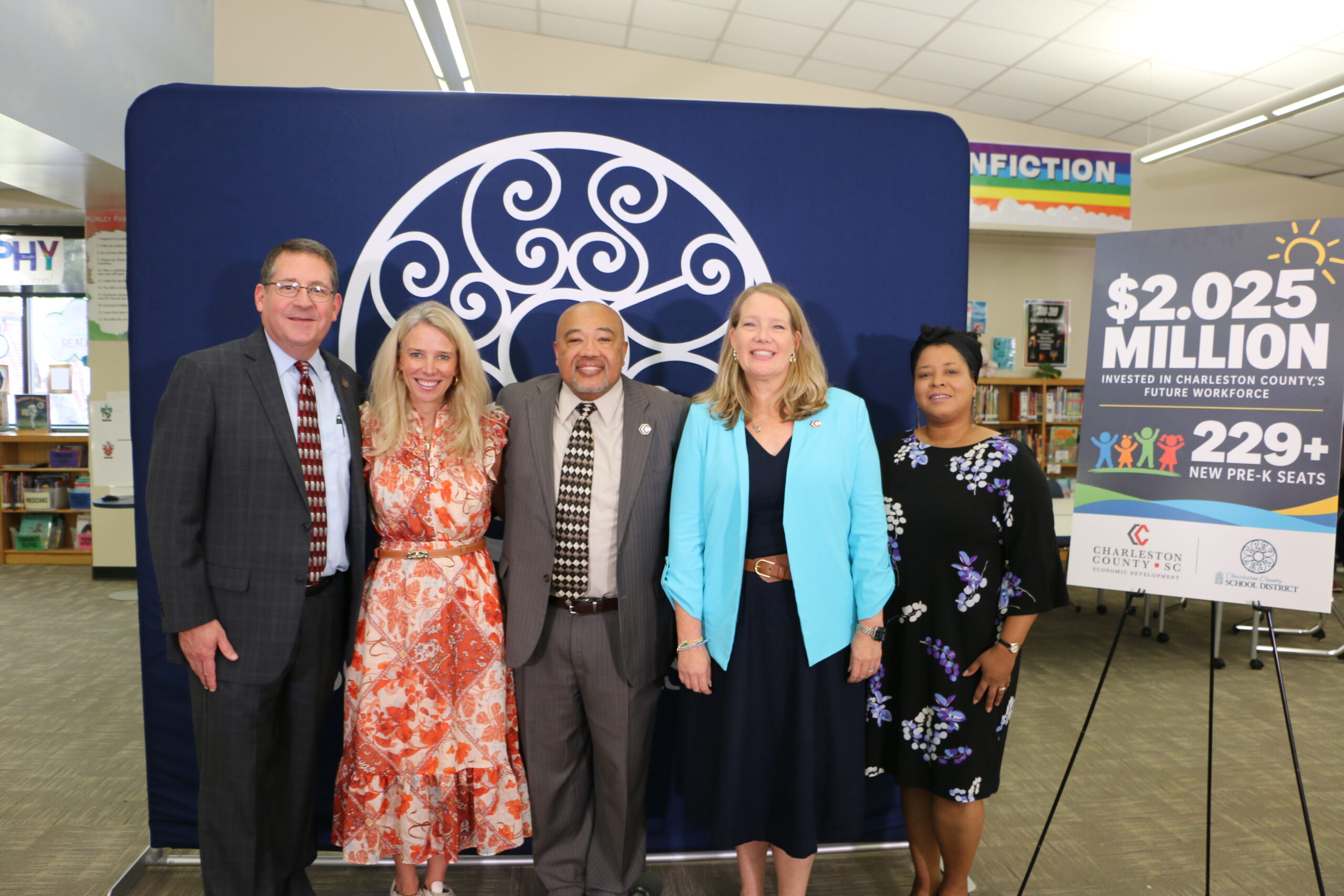
Charleston County Economic Development (CCED) is investing $2.025 million in Charleston County School District’s expansion of Universal Pre-K in North Charleston, a major partnership designed to support young children, working families, and the region’s workforce.
Through the partnership, funding donated will help create at least 229 new Pre-K seats in North Charleston. The investment builds on CCSD’s launch of its first Universal Pre-K program at Charleston Progressive Academy on the Charleston Peninsula this school year and marks the next major step in the district’s plan to expand access to early learning across Charleston County.
This investment recognizes that access to early childhood education has an impact far beyond the classroom. For many families, reliable, high-quality Pre-K can help parents and caregivers to enter the workforce, work additional hours, remain employed, or pursue education and training. Those workforce impacts will be among the outcomes evaluated as the initiative moves forward.
“We are so grateful for CCED coming alongside us with this historic investment,” said CCSD Superintendent Anita Huggins. “Universal Pre-K gives our youngest learners a strong start, but we know its impact reaches the entire family. This partnership will open doors for hundreds of children while giving parents and guardians greater opportunities to work, learn, and build a stronger future for their families. We are incredibly grateful to Charleston County Economic Development for believing in this work and investing alongside us.”
The partnership represents an innovative approach to workforce development and recognizes that access to affordable, high-quality early learning is essential infrastructure for supporting a growing economy.
“Childcare is a workforce issue, an economic development issue, and a family issue,” said CCSD Chief Financial Officer Daniel Prentice. “This investment allows us to address all three at once. By bringing public education and economic development together, we can use our resources in a way that directly benefits our children today while helping more parents participate fully in our local economy.”
As the expansion moves forward, CCSD and its partners will measure not only the number of new seats created and filled, but also the broader impact on participating families, including employment, work hours, education and training opportunities, prior childcare costs, and barriers families face in accessing early learning.
“I commend Charleston County Economic Development for recognizing that some of the most significant barriers to workforce participation begin outside the workplace,” said Charleston County Council Chairman Joe Boykin. “This investment demonstrates the forward-thinking approach needed to support working families and strengthen our economy.”
“The strongest economies are built long before a person’s first day on the job,” added CCED Executive Director Merle Johnson. “They begin when children have the opportunity to learn and when parents have the support they need to participate fully in the workforce. This investment is not simply about creating additional Pre-K seats; it is about removing a barrier for families and strengthening our workforce and economy for generations to come.”
The North Charleston Universal Pre-K expansion is part of CCSD’s broader commitment to increasing access to high-quality early learning opportunities across Charleston County. This school year, CCSD opened its first Universal Pre-K program on the Peninsula at Charleston Progressive Academy.
Plans are already underway to expand Universal Pre-K next school year to additional communities, including North Charleston, East Cooper, James Island, Johns Island, and West Ashley with new opportunities planned at North Charleston Elementary, Jennie Moore Elementary, Laurel Hill Primary, James Island Elementary, and Hunley Park Elementary. The continued expansion will give more children a strong start while helping CCSD better understand the impact of Pre-K access on families, workforce participation, and student outcomes.
“This is bigger than adding classrooms,” Huggins said. “It is about what becomes possible for a child, a parent, and ultimately an entire community when we remove a barrier and create an opportunity.”